
A chain of curiosities—each link a different word.
The colour pink does not exist.
There is no single wavelength of light that is pink. Think of a rainbow… red, orange, yellow, green, blue, indigo and violet. No Pink. So where does the colour pink come from?
Technically, light doesn’t have a colour, it has a wavelength. Humans typically see light in the visible light spectrum, a linear arrangement of energy wavelengths (380 to 700 nanometres (nm)).
To perceive a colour, a specific wavelength of light must be detected by specialised cells at the back of our eyes. We call these cone cells and humans typically have three types, those that detect a range of short, medium and long wavelength light; often referred to as blue, green and red cone cells, respectively. The cone cells register how much of each wavelength of light they have received and send this information to the brain, where it is processed and interpreted as colour.
Each cone cell detects light around the wavelength of their namesake, so blue cones are activated to the maximum when blue light hits them (420-440 nm); for green cones it’s 535-545 nm light and for red it is 564-580 nm light.
Simple enough for red, green and blue wavelength light, but what about a colour that has a different wavelength? Although each cone cell has an optimal wavelength light activation, they do get activated to varying degrees by a range of wavelengths, and these ranges overlap.
Light with a wavelength of 570nm, for example, is yellow. When yellow light enters our eyes, the red and green cones get activated, as their detection ranges cover this wavelength, and our brains interpret this information as yellow. So what is the problem with pink?
There is no single wavelength of light for pink. It is a blend of other colours. Light reflected from a pink object would activate our red and blue cones; but green sits between red and blue on the visible light spectrum so we would expect our green cones to activate. They don’t. Our brains receive the information that the colour is a mix of red and blue, but it’s not green. So it comes up with a different colour solution, and we call it pink.
*******
Speaking of pink… did you know that it was used as a camouflage colour in World War II by the British Navy? Apparently, Captain Louis Mountbatten decided pink would be the perfect colour to paint the Royal Navy’s 5th Destroyer Flotilla, of which he was commander. It is said that Mountbatten took inspiration from a fleet of ships his flotilla was accompanying in 1940. Mountbatten noticed that one of the ships, painted in a lavender colour, disappeared from view sooner than it’s grey-painted counterparts. He felt that the colour provided a level of camouflage to the ships at dusk and dawn, times when U-boats were more likely to attack.
Mountbatten had his own version of the colour mixed from a blend of mid-grey with a small amount of Venetian red (nowadays the colour is formally composed, in a CMYK colour space, of 0% cyan, 20.3% magenta, 7.8% yellow and 40% black). No official study was carried out to confirm any advantage to the colour, some felt it actually created more of a disadvantage, particularly at midday, when there was no pink hues in the sky.
While the colour was, for the most part, replaced by grey by 1942, Mountbatten’s approach at least opened up more innovation and creativity when it came to wartime camouflage.
*******
Speaking of camouflage… what comes to mind when you hear the word? Maybe an artic fox with its seasonal coat changes, allowing it to blend in to its surroundings? Or perhaps an insect, perfectly coloured and shaped to look like a leaf? But how about a caterpillar that avoids beings eaten by disguising itself as a piece of… bird poo? That’s what the Giant Swallowtail caterpillar (Papilo cresphontes) does to increase its chances of surviving the larval stage of its life cycle.
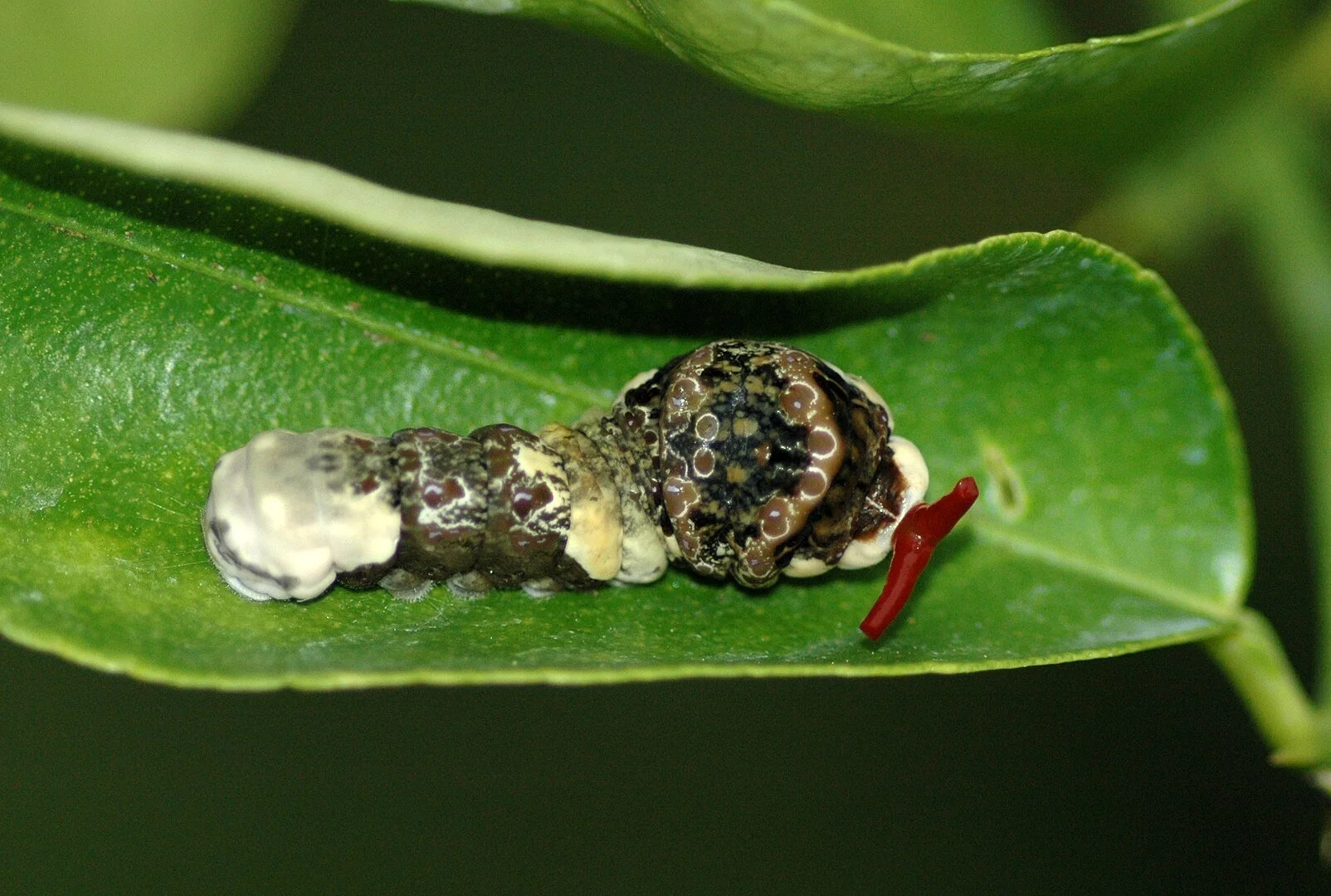
By Ianaré Sévi - Own work, CC BY-SA 3.0, https://commons.wikimedia.org/w/index.php?curid=3434608
What I love about this camouflage story is the caterpillar’s level of commitment. It is all in on this disguise, because, not only does it look like excrement, but if threatened, it released a pungent chemical, similar in odour to… you guessed it, faeces. It even has a specialised gland, called an osmeterium, that it extends out, like a forked tongue, when releasing the foul odour.
Thankfully, life isn’t all bad for the Giant Swallowtail caterpillar. It grows up to become a beautiful butterfly with impressive black wings and vibrant yellow colouring; completely void of the palette of bird poo.
*******
Speaking of poo… dung beetles are masters at cleaning up the stuff. They are important for our ecosystem, assisting in recycling the nutrients in dung as well as playing a role in seed distribution. But sometimes there is a lot of competition for a limited resource and dung beetles must adapt. Which is why there are reports of dung beetles, like the Canthon aff. quadriguttatus species, that have decided to beat the competition and go straight to the source. They have been observed hanging around the anal region of two different monkey species in Peru, brown titi monkeys (Callicebus brunneus) and bald-faced saki monkeys (Pithecia irrorata). When the monkeys defecate the beetles drop with the dung to the forest floor, managing to claim some of the spoils before their ground-foraging counterparts arrive.
So, when dung is a hot commodity, sometimes it pays to sit and wait on a monkey’s bottom.
*******
Speaking of bottoms… have you ever seen a wombat’s posterior before? Wombats are cute and furry, they look a little like large guinea pigs … but don’t be fooled, when it comes to their derrieres, they are less soft and squishy and more buns of steel.
Wombat bums are made up of four fused plates so they are hard as rock. The plates are covered in cartilage, fat and fur,giving them the impression of softness, but these bottoms are heavy on defence, rather than cuteness.
When threatened, a wombat will run for its burrow; but rather than hide deep inside, they will sit just at the entrance, plugging them with their large bottoms. Even if it can’t make it to its burrow, a wombat will turn its rear to any potential threat. So one end may be cute and cuddly, but the other end is more about reinforcement and defence.
*******
Speaking of defence… there is so much to choose from here, but I am going to overlook the lizard that squirts blood from its eyes (horned devil) and the hagfish that attempts to choke its predators with litres and litres of home-made slime, and focus instead on exploding ants.
Colobopsis explodens is a species of exploding ants discovered in 2018. On first observation, these small ants appear to have no extreme defence weaponry. They are reddish-brown in colour and live in trees in the rainforests of Borneo. But these relatively harmless looking creatures can go to extremes when it comes to defending the colony. If a threat, such as a larger weaver ant, does not back off, these ants will clamp onto the attackers body; they then flex their abdomens with incredible force until they rupture, like an explosion, releasing a toxic secretion that sticks to the body of their adversary.
This bright yellow goo, stored within glands along the ant’s body, is reported to have a mild, spicy or curry like odour. It is usually fatal to the predator. For one of the most unusual, and selfless acts of defence, (a process known as autothysis) I think the award must go to these exploding ants.
*******
Speaking of ants… do you know what is probably even more amazing than exploding ants? Ants that take other ants as their slaves. There are many species of ants that do this, but Polygerus breviceps ants are one species that do it really well. In fact, that’s all they are good at. These ants seem to have sacrificed their ability to care for brood, tend their nests and even feed themselves. They need slaves to carry out all their basic life tasks; so how do they do it?
Scouter ants will locate a potential raid nest of their target ant species (often Formica ants) and share this information with their sisters. The Polygerus ants set out and raid in one quick attack. It is thought that they subdue and confuse the defending ants with chemical weaponry (pheromones). The lightning raid is successful once they identify, and carry away, brood from the raided ant nest. Safely back home they use another cocktail of pheromones (in particular cuticular hydrocarbons) to imprint on the stolen brood. These hatch as compliant slaves, automatically carrying out all the tasks that their captors do not perform, such as brood care, nest maintenance, foraging and even feeding their enslavers.
In the ant world, they are literally waited on hand and foot . Polygerus may be very bad at just about everything, but they are top class social parasites.
*******
Speaking of parasites… the word usually conjures up ideas of insects or fungi taking over another organism with detrimental effect. Black holes probably don’t come to mind, but maybe they should. A recent study suggests that black holes, formed within seconds of the Big Bang, could be contained within the core of certain stars. These black holes, often referred to as primordial black holes, would be smaller than the giants thus far observed. Steven Hawking first proposed the possibility of these primordial black holes in the 1970s, even suggesting that one may be contained within our Sun.
So what do these black holes potentially do? The study suggests that, if a black hole the size of a dwarf planet is present at the core of a star, it could be consuming the host star from within. A parasitic black holes.
*******
Speaking of black holes… some of them are pink! At least that’s what one researcher observed back in the late 1990’s. An observation that caused quite a stir at the time.
To be clear, black holes, by their very nature, are black. They are so powerful that they suck everything, even light, in and are therefore the absence of any light at all. The pink light observed is likely coming from just outside the black hole itself, emitted from matter, stars or gas as they are drawn towards the event horizon, or rim, of the black hole.
The actual colour was only reported when the researcher applied red, green and blue filters, to represent how these black holes would look to the human eye. It turns out they would look garishly bright and pink. Of course, that could spark its own controversy, as we all know…
… the colour pink does not exist.
